


CENTRAL ASIA · 13 DAYS · AUGUST 13–25, 2028
Beyond the Silk Road 2028 — Between Steppes, Mountains and Millennial Cultures
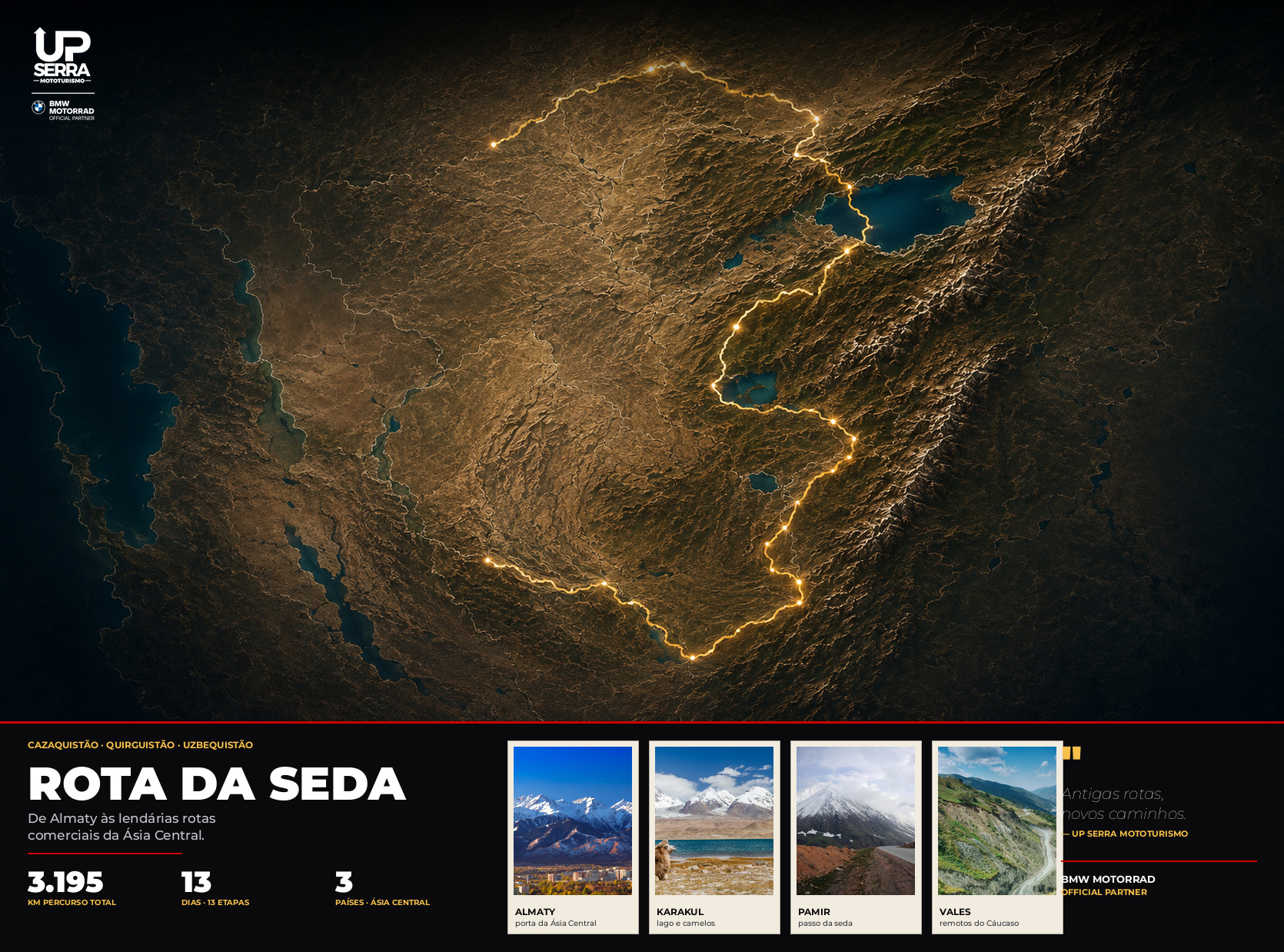
~3,200 km through Kazakhstan, Kyrgyzstan and Uzbekistan —
Charyn Canyon, Song Kol at 3,016m, Tash Rabat and Samarkand at the origins of civilization.
The Silk Road isn’t a path — it’s an idea. For two millennia, it connected civilizations that should never have met: Rome and Chang’an, Alexandria and Samarkand, the nomads of the steppes and the emperors of China. Today, that corridor survives in fragments scattered across countries the world has almost forgotten — and that’s exactly why it’s worth experiencing on a motorcycle, unhurried, with full attention. Beyond the Silk Road 2028 crosses three Central Asian republics in 13 days: Kazakhstan, Kyrgyzstan and Uzbekistan. Three countries, three languages, three worlds separated by borders that, 35 years ago, were still a single Soviet nation.
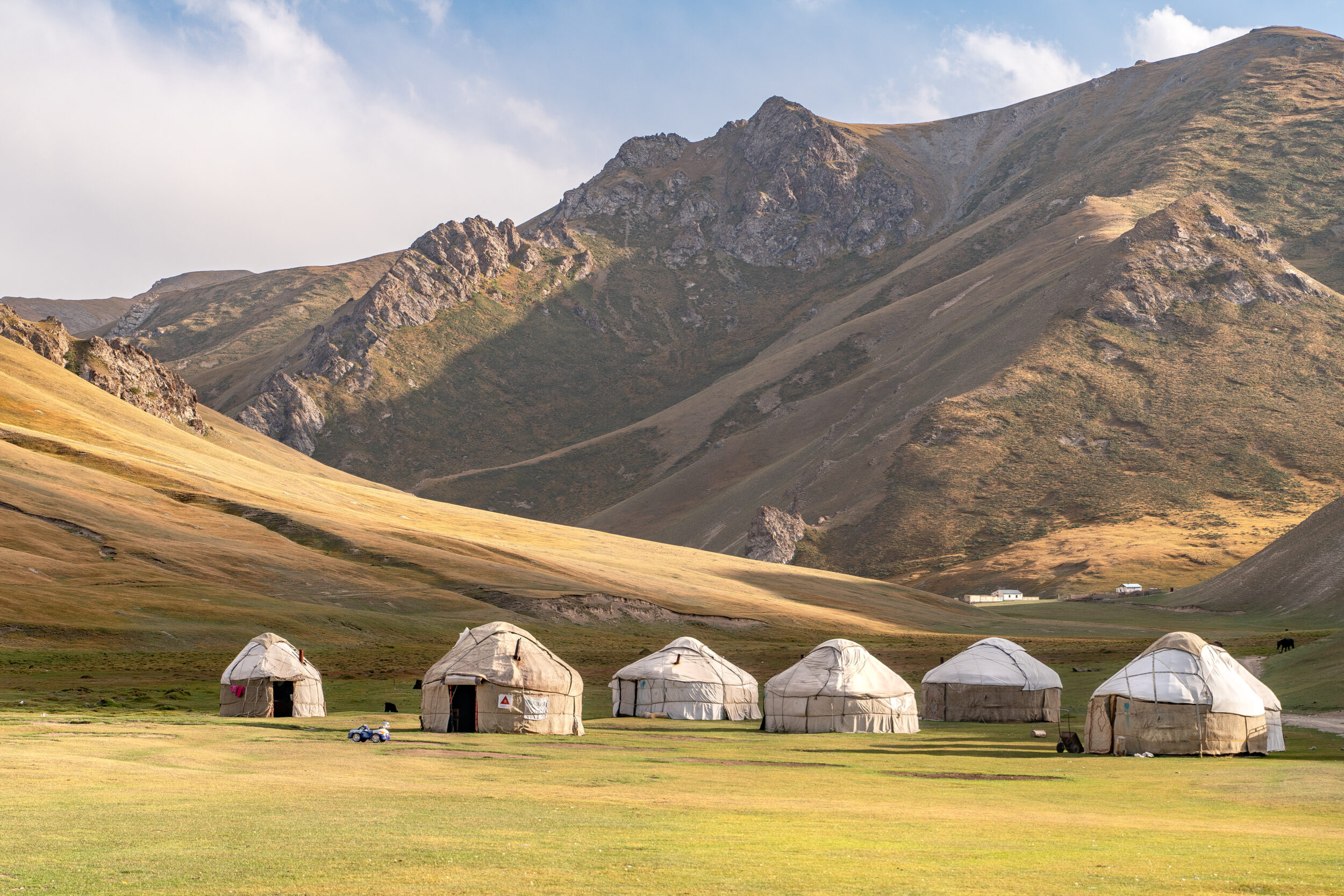
The route leaves Almaty — the southern Kazakh metropolis set against the Tian Shan — and plunges straight into the landscape that defines the region: Charyn Canyon, a miniature echo of the American Grand Canyon, carved into layers of red sandstone. The entry into Kyrgyzstan runs along the northern shore of Lake Issyk-Kul, 170 km wide and a constant 10°C even in August. The heart of the route is the detour to Lake Song Kol, at 3,016 meters — an alpine plateau where Kyrgyz nomadic herders still spend the summer in felt yurts, exactly as their ancestors did a thousand years ago. One night here is mandatory.
The descent from Song Kol leads to Tash Rabat — a 15th-century stone caravanserai preserved in the middle of nowhere, exactly where camel caravans rested before crossing the Pamir. The crossing into Uzbekistan enters through the Fergana Valley, cradle of silk and cotton, and reaches Tashkent before turning north through the Kazakh semi-desert toward Turkistan — where the 14th-century Great Yasawi Mosque was built by order of Tamerlane. The final return to Almaty via the north completes the 3,200 km loop with roughly 70% paved roads and 30% dirt — including the approaches to the Kyrgyz gorges, which demand attention but reward with views that exist nowhere else.
IN PICTURES
UpSerra Mototurismo in motion
For over 6 years, taking Brazilian riders to the best roads in the world. That’s how UpSerra does it — on the road, present, with people who know how to ride.

More videos on the channel @upserra on YouTube →
THE ROUTE
3,200 km loop through Central Asia
ITINERARY
13 days crossing Central Asia
Arrival in Almaty, Kazakhstan’s largest city, set at the foot of the Tian Shan with snow-capped peaks visible from downtown. Check-in, motorcycle handover and a full expedition briefing with the UpSerra team. Almaty is a surprise — cosmopolitan, green, with an unexpectedly good food scene. Free evening to explore the Green Bazaar and the bars of Arbat Street before 12 days on the road.
The first day already delivers on what Central Asia promises. Departure from Almaty heading southeast on the A-351, with the Tian Shan steadily rising on the left. The main highlight is Charyn Canyon — a red sandstone geological formation carved by the Charyn River over 12 million years. The walls reach 300 meters in height, in layers of ochre, orange and violet that shift color with the angle of the sun. A miniature — but no less dramatic — version of the American Grand Canyon. Overnight in the small town of Saty, gateway to the Tian Shan passes.
The border crossing into Kyrgyzstan and the first view of Lake Issyk-Kul — the world’s second-largest alpine lake, 170 km long, 60 km wide, with a year-round temperature of 10°C thanks to its 668-meter depth. The route runs along the lake’s southern shore, with constant views of turquoise water against the snow-capped peaks of the Tian Shan. Arrival in Karakol, the last major city east of the lake, home to its curious wooden Orthodox church and the most authentic livestock bazaar in Central Asia.
Skirting the far southern tip of Issyk-Kul and crossing into inland Kyrgyzstan. The route crosses pasture valleys where wild horses share the land with sheep herds driven by mounted shepherds — scenes that seem to belong to another century. The road along the Kara-Darya river valley is exactly the kind of pavement UpSerra looks for: perfect, curving, traffic-free, with permanent mountains on the horizon. Arrival in Kochkor, a small town that serves as the logistics base for the climb to Song Kol the next day.
The most technical day of the route — and the most rewarding. The climb to Lake Song Kol (3,016m) begins on pavement out of Kochkor and soon turns into compacted dirt tracks climbing through a sequence of alpine passes. The asphalt ends, the landscape opens up, and the world that existed below simply disappears. At the top of the plateau: a 270 km² lake set in a plain of intensely green grass, surrounded by mountains, without a single permanent structure in sight — just felt yurts and hundreds of free-roaming Kyrgyz horses. Song Kol is one of the few places on the planet where the 21st century still hasn’t truly arrived.
Free day at Song Kol. Nobody climbs to 3,000 meters just to keep moving. The UpSerra team arranges the night in traditional Kyrgyz yurts with local herders — nomadic hospitality includes kumis (fermented mare’s milk), stone-baked bread and stories told through gestures. The day may include an optional horseback ride around the lake, a walk along the slopes, or simply sitting in the absolute silence of the plateau, watching the light shift over the water and the mountains. One of the rarest experiences UpSerra has ever built into an itinerary.
The descent from Song Kol to the valley and the continuation south toward Tash Rabat — a 15th-century stone caravanserai built exactly at the point where Silk Road caravans rested before crossing the Pamir. The building is remarkably well preserved: a central dome surrounded by side chambers carved into the rock, still serving the same function it did 600 years ago. The feeling of standing where merchants, Buddhist monks and Tamerlane’s soldiers once passed is literal — the marks are still there. The final approach to Tash Rabat is on a dirt track through an enclosed valley.
The longest day of the route — and one of the most varied. From Tash Rabat, the descent through the Kara-Darya Valley returns to the Kyrgyz plains, where the road picks up speed and the horizon opens wide. The middle stretch crosses moderate-altitude passes with constant views of the Pamir peaks in the distance. Arrival in the Fergana Valley on the Kyrgyz side: the temperature rises, the air dries out and the landscape changes completely — from cold mountain steppe to the plane trees and cotton fields of Central Asia’s most populous valley. Overnight in Jalal-Abad, the border point into Uzbekistan.
Crossing the land border into Uzbekistan and entering the Fergana Valley — considered the historic birthplace of silk, cobalt-blue ceramics and the spices that gave the Silk Road its name. The valley is an oasis surrounded by deserts and mountains, dense and fertile, with smaller towns like Rishtan and Kuva home to artisan families who have made ceramics the same way for fifteen generations. Fergana is the hub of the valley, with its central bazaar where handmade silk, Doppi caps and the famous Fergana walnuts can still be found. First Uzbek night.
Crossing Uzbekistan from east to west on the M-39 highway, crossing the passes that separate the Fergana Valley from the rest of the country. Arrival in Tashkent — capital of Uzbekistan, 2.5 million inhabitants, a city entirely rebuilt after the 1966 earthquake, with the monumental Soviet architecture that still dominates the skyline. The contrast is what makes Tashkent unique: the most beautiful metro in Central Asia (built to double as a nuclear shelter), right next to Chorsu Bazaar, where everything from dried fruit to Kyrgyz carpets can be found. Dinner at an Uzbek restaurant with plov, lagman and samsa.
Crossing back over the border into Kazakhstan from the south and continuing toward the city of Turkistan — one of the most important places in the medieval Islamic world, and still one of the most visited pilgrimage centers in Central Asia today. The Great Yasawi Mosque, built by order of Tamerlane in 1389, is a UNESCO World Heritage Site of monumental proportions — the largest fired-brick structure in medieval Islamic history. For centuries, a pilgrimage to Turkistan counted as a third of the Hajj to Mecca. Overnight with the illuminated turquoise dome visible from the hotel.
The last long stage of the route, crossing the steppes of southern Kazakhstan on the M-39. The steppe landscape has its own grandeur: an absolutely flat horizon that grows increasingly mountainous as the route approaches the east. Taraz is one of the oldest cities in Kazakhstan — with over 2,000 years of recorded history as a trading center — with the Karakhan Mausoleum and Taraz Bazaar as highlights. Last night before the return to Almaty.
The longest day in distance, but the most direct in route — the M-39 runs parallel to the Tian Shan with the peaks permanently on the right. As the group nears Almaty, the mountains once again dominate the horizon — the same snow-capped peaks that marked the departure 12 days before. Motorcycle return happens in the late afternoon, followed by the closing dinner. Three hundred and twenty-seven days on the calendar, 13 days on the road, 3,200 km, 3 countries, 3 borders, 1 lake at 3,016 meters, 1 night in a yurt, and the feeling of having crossed a living piece of history.
The itinerary may be adjusted during the trip. Road conditions, weather, border situations, accommodation availability or the group’s own condition may lead the UpSerra team to change legs, the order of stages or overnight stops. The destination, the duration and what is included are maintained — the path to get there may change, and the decision is always operational and safety-driven.
THE PACKAGE
What’s included
Included
- Full itinerary planned and guided by UpSerra
- UpSerra guide accompanying the entire route
- Selected hotels (11 nights) + 1 night in a traditional yurt (Song Kol)
- Breakfast every day
- Adventure trail bike prepared for mixed terrain (pickup and drop-off in Almaty)
- Support vehicle with full logistics support
- Assistance crossing all 3 land borders
- Professional trip photography and filming
Not included
- Airfare to Almaty (round trip)
- Visas for KZ, KG and UZ (guidance provided by UpSerra)
- Fuel
- Meals (except breakfast)
- Motorcycle deposit (charged at pickup)
- Personal expenses
- International travel insurance
- Any item not listed as included
- Tourist fees and local taxes — paid directly by the participant
INVESTMENT
Tour pricing
| Modality | Price |
|---|---|
| Rider — single room | US$ 11,500 per person |
Riders-only expedition. At specific points of the route where local infrastructure is limited — such as the yurt night at Song Kol — sharing accommodation may be necessary.
WHO IT’S FOR
Requirements
- Valid driver’s license — more specific guidance is provided by the UpSerra team upon registration confirmation
- Experience riding mixed terrain — Adventure level: 30% of the route is dirt and tracks, including alpine passes accessing Song Kol above 3,000m
- Valid passport with at least 6 months’ validity beyond the return date — consult the UpSerra team for specific guidance on visas for KZ, KG and UZ
- Mandatory international travel insurance covering all 3 countries, including medical assistance, repatriation and coverage for motorized activities
- Full gear for changing weather: full-face or adventure helmet, armored jacket and pants, adventure boots, waterproof gloves — temperatures at Song Kol can drop below 5°C even in August
- Adequate physical conditioning — altitude above 3,000m on consecutive days requires good adaptation; any history of heart or respiratory issues must be reported to the team
Reserve your spot
Fill out the form and UpSerra will get in touch to confirm availability and details for Beyond the Silk Road 2028.
✓ We’ve received your registration!
The UpSerra team will get in touch soon via the WhatsApp number provided.
FREQUENTLY ASKED QUESTIONS
Questions about the tour
Steppes, mountains and millennial cultures. Central Asia exists — and it fits on a motorcycle.
13 days, 3 countries, 1 night in a yurt at 3,016 meters — and the certainty of having been somewhere few Brazilians have ever gone.